

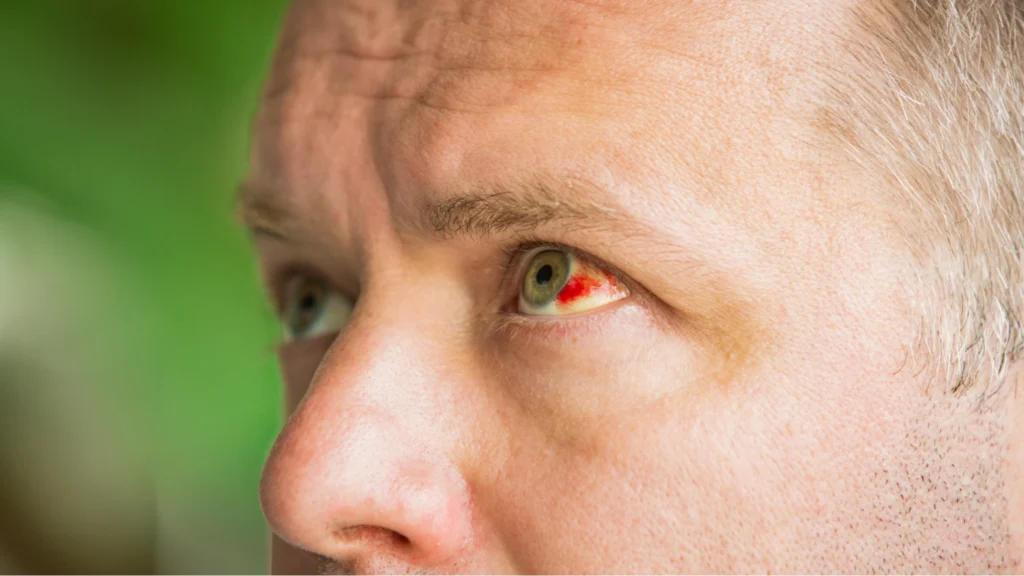
You glanced in the bathroom mirror this morning and froze. One patch on the white of your eye has gone bright, solid red, like someone spilled paint just under the surface. It looks dramatic. It may have shown up overnight with no warning, and now you’re wondering if something just went seriously wrong. Here’s the short version, and the part most people are relieved to hear: a blood spot in your eye, called a subconjunctival hemorrhage, is almost always harmless and clears up on its own within a couple of weeks. In this post, we’ll walk through what that red spot on your eye actually is, why it happened, how long it sticks around, how to tell it apart from pink eye, and the specific signs that mean it’s worth getting checked. By the end, you’ll know whether you can relax or book an exam.
A blood spot on your eye, explained
A subconjunctival hemorrhage is a broken blood vessel sitting just under the clear film that covers the white of your eye. That film is called the conjunctiva, and when one of its tiny vessels breaks, blood leaks out and pools between the film and the white of the eye instead of being absorbed right away. Because it has nowhere to go at first, it spreads into that flat, vivid red patch you’re staring at. Think of it as a bruise that happens to land somewhere very visible.
The reason it looks so alarming is the contrast. Bright red blood against a white background grabs your attention in a way the same bruise on your arm never would. The blood sits on the surface of the eye, not inside it, so it doesn’t involve your cornea or affect your vision at all. Most people don’t even notice it until they look in a mirror or someone points it out, because other than the red patch, there’s usually no pain, no swelling, and no discharge.
Why does a blood vessel in your eye break?
Most of the time, a popped blood vessel in the eye traces back to a quick spike in pressure. A hard sneeze, a coughing fit, vomiting, straining on the toilet, or lifting and bending forward can all briefly raise the pressure in those small veins, and a fragile vessel gives way. Rubbing your eye too hard does it, too, as can a minor poke while taking out a contact lens. Sometimes there’s a clear trigger you can point to. Often, there isn’t, and that’s completely normal, since the cause of a subconjunctival hemorrhage frequently can’t be found. Plenty of people wake up with a red spot in the eye and no pain, with no clue what set it off.
A few things make these spots more likely. Wearing contact lenses raises the odds a little, and so does age, with people 65 and older seeing them most often, especially alongside high blood pressure or diabetes. Blood thinners and antiplatelet medications increase the risk, too, and they can make the patch look bigger or take longer to clear. Recent eye surgery, such as cataract surgery, can leave one behind as well. None of these means something is wrong on its own. They just tip the scale.
How does a blood spot differ from pink eye?
This is the part that trips people up, because a red eye and a blood spot aren’t the same thing. A subconjunctival hemorrhage is a solid, sharply outlined patch of red sitting in one area, with a clean edge against the normal white around it. It doesn’t itch, it doesn’t weep, and unlike infectious pink eye, it isn’t contagious and comes with no discharge or light sensitivity.
Pink eye looks different. Conjunctivitis tends to show up as redness spread out across the eye, along with itchy, watery eyes and sometimes a yellow or green discharge. So if you’ve got discharge, itch, or both eyes turning bloodshot, you’re likely looking at pink eye, not a burst vessel. One flat red patch and nothing else points the other way.
How long does a subconjunctival hemorrhage take to heal?
A blood spot in the eye clears on its own. Most resolve within one to two weeks, though a larger patch can take up to three weeks to fully fade. There’s no drop, ointment, or trick that speeds it up, since your body simply reabsorbs the trapped blood at its own pace. Expect it to change colour as it goes, the same way a bruise on your skin does, shifting from red to brown to a yellowish tinge before it disappears.
One thing throws people off. The patch can look bigger in the first 24 to 48 hours before it starts to shrink, but that spreading is just the blood settling under the film, not new bleeding, and it’s part of normal healing.
When a red spot on your eye is worth a closer look
Here’s the honest part. A blood spot on its own, with no pain and clear vision, rarely needs urgent care. But a few signals change the picture. Get your eye looked at promptly if you have eye pain rather than mild scratchiness, any blurring or change in your vision, sensitivity to light, or blood that seems to sit over the coloured part of your eye. That last one can point to a hyphema, which is bleeding inside the front of the eye and does need a doctor right away.
Two other situations deserve attention. If the red spot follows a real injury, such as a knock to the head or eye, it should be checked rather than waited out. And if these spots keep coming back, that’s a reason to dig a little deeper. Recurring hemorrhages can occasionally flag unrecognized high blood pressure, a medication effect, or, less commonly, a bleeding disorder worth a simple blood test. A spot that hasn’t cleared within about three weeks is also worth a visit. For little ones, a blood spot in a baby’s eye is often just the pressure of delivery and settles on its own, but a child with eye pain, a history of injury, or a spot nobody can explain should be seen.
What you can do while it heals
For a routine blood spot, the best thing you can do is leave it alone and let it run its course. If the eye feels scratchy, preservative-free artificial tears can take the edge off, and a cold compress in the first day can feel soothing, though neither clears the redness any faster. Skip the rubbing and use lubricating drops instead if your eye is irritated. Stay away from get-the-red-out vasoconstrictor drops, which do nothing for this and can irritate the eye.
If you wear contacts, take them out. Leave them out until the redness is gone and the eye feels comfortable again, and an eye doctor can advise when it’s safe to go back to your lenses. When in doubt about any of this, that’s exactly the kind of quick question the team at LMC Optometry & Eye Care is happy to answer.
A simple rule of thumb
Most of the time, a red spot on your eye is your body making a small thing look like a big one, and it’ll sort itself out in a couple of weeks. Still, if something feels off, if there’s pain, a vision change, an injury behind it, or the spots keep returning, it’s always better to have a professional take a look than to guess. If you’re searching for an “optometrist near me” in Barrie, Thornhill, Brampton, or anywhere else across our Ontario locations, LMC Optometry & Eye Care can examine your eyes and give you a straight answer. You can book an eye exam online or reach out to your nearest clinic, and if it turns out to be something more urgent, our emergency eye care team can see you quickly.
Frequently Asked Questions
Is a blood spot in my eye serious?
Almost always no. A blood spot, or subconjunctival hemorrhage, is a broken vessel on the surface of the eye. It’s painless, doesn’t affect vision, and clears on its own. It only needs attention if there’s pain, a change in vision, a recent injury, or it keeps coming back.
How long does a subconjunctival hemorrhage take to go away?
Usually one to two weeks, and up to three for a larger spot. It fades like a bruise, from red to brown to yellow, and there’s nothing that speeds it up.
Can I wear contact lenses with a blood spot in my eye?
It’s best to take them out and leave them out until the redness is gone and the eye feels normal. An eye doctor can confirm when it’s safe to resume wearing them.
Does a blood spot in the eye mean high blood pressure?
A single spot usually doesn’t. Repeated blood spots can sometimes be linked to high blood pressure, a medication effect, or a clotting issue, which is why recurring ones are worth checking.
What’s the difference between a blood spot and pink eye?
A blood spot is one solid red patch with no itching or discharge, and it isn’t contagious. Pink eye is spread-out redness that usually comes with itching, watering, or discharge.
When should I see an optometrist for a red spot on my eye?
Not for a routine, painless spot. See one promptly if there’s eye pain, blurry vision, light sensitivity, a recent injury, blood over the coloured part of the eye, repeated spots, or a spot that hasn’t faded after about three weeks.