

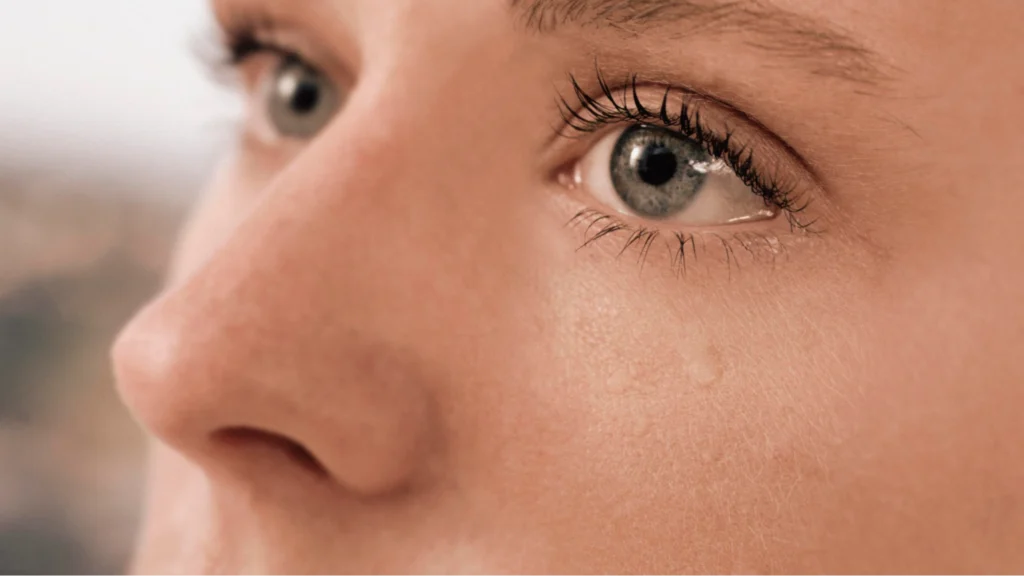
If your eyes keep welling up for no clear reason, you’re not crying, and you’re tired of dabbing them with a tissue all day, you’re in the right spot. Watery eyes happen for one of two reasons: your eyes are making too many tears, or those tears aren’t draining the way they should. The most common watery eye causes include dry eye, allergies, blocked tear ducts, eyelid problems, and everyday irritants like wind and screens. Here’s the part that surprises people. Dry eyes are one of the biggest reasons eyes won’t stop tearing. We’ll walk you through why that happens, what else could be going on, and when it’s worth booking an eye exam.
What’s really happening when your eyes water
Tears do a lot more than show up when you’re upset. A healthy tear film keeps the surface of your eye smooth, comfortable, and clear every time you blink. Those tears then drain out through tiny openings called puncta in the inner corners of your eyelids, travel down small channels, and empty into your nose. That’s why a good cry leaves you sniffling. The medical name for watery eyes is epiphora, and it shows up when your eyes either produce more tears than that drainage system can keep up with, or when something narrows or blocks the drain. Either way, the tears have nowhere to go but over your lower lid and down your cheek.
What are the common causes of watery eyes?
Most tearing comes down to a short list of usual suspects. Here’s what we see most often at LMC Optometry & Eye Care.
Dry eye, believe it or not
This is the one that confuses almost everyone. When the surface of your eye gets dry and irritated, it sends a distress signal to your tear glands, which respond by flooding your eye with emergency tears. The catch is that these reflex tears are mostly water. They’re missing the oil and mucus that balanced tears have, so they can’t coat your eye properly. They pour in, drain away quickly, and leave your eye just as dry as before, which kicks off another round of watering. It’s a frustrating loop, and it’s why someone with watery eyes can still feel stinging, burning, or grittiness in between.
Allergies
Pollen, dust, pet dander, and mould all push your tear glands into overdrive as your eyes try to flush the irritant out. Allergy tearing usually comes with itching, redness, and a gritty feeling, and it tends to flare during Ontario’s pollen-heavy spring and ragweed-heavy late summer. If your eyes water and itch at the same time every year, allergies are a likely driver.
Blocked or narrowed tear ducts
When the drain itself is the problem, tears back up and overflows even though your eye isn’t making extra. Blocked tear ducts are one of the most common causes of watering, especially in babies and older adults. Many newborns are born with a duct that hasn’t fully opened, and it usually clears up on its own within the first several months. In adults, the ducts can narrow with age or after repeated inflammation, and tearing tends to be constant rather than triggered by anything in particular.
Eyelid problems
Your eyelids work like little squeegees, sweeping tears toward the drain with every blink. As we get older, the lower lid can sag and turn outward (ectropion) or roll inward (entropion), and either one throws off tear drainage. An eyelash growing in the wrong direction can rub the surface of the eye too, setting off a steady, low-grade watering on that side.
Wind, cold, smoke, and screens
Plenty of everyday tearing is just your eyes protecting themselves. A gust of cold wind on a Barrie winter morning, a smoky room, or dusty air will all trigger a quick flood of reflex tears to wash things away, and it settles once you’re out of it. Screens are sneakier. We blink far less when we’re locked onto a laptop or phone, the tear film dries out, and the eyes water to compensate.
Infections and irritation
Pink eye (conjunctivitis) and inflamed eyelid margins (blepharitis) both make eyes water, usually alongside redness, crusting, or discharge. And anytime something gets in your eye, an eyelash, a speck of grit, a flake of mascara, your eye will tear up hard to flush it out.
Why does one eye water more than the other?
When only one eye streams, the cause is usually something local on that side. A partly blocked duct, a stray lash rubbing the surface, a bit of trapped debris, or an eyelid that isn’t sitting quite right will all affect one eye on its own. Tearing in both eyes points more toward dry eye, allergies, or the environment around you.
When watery eyes need an eye doctor
Most tearing is harmless and calms down on its own. It’s worth getting checked when the watering sticks around for more than a few days, blurs your vision, or comes with pain, redness, discharge, or swelling. Pain and tearing that are worse first thing in the morning are also worth mentioning, since they can point to a surface issue on the cornea. Epiphora is straightforward to diagnose, and an optometrist has the right equipment to find out whether it’s a tear-quality problem, a drainage problem, or something on the eyelid. If you’ve been searching for an optometrist near me around Thornhill, Barrie, or Brampton because the tearing just won’t quit, that’s a perfectly good reason to come in.
What actually helps
The fix depends entirely on the cause, which is why guessing rarely works. For dry-eye-related tearing, preservative-free lubricating drops, warm compresses, and good eyelid hygiene help rebuild a stable tear film. Allergy tearing responds to antihistamine drops and steering clear of triggers. The 20-20-20 habit (every 20 minutes, look at something 20 feet away for 20 seconds) keeps screen-related dryness in check, and sunglasses cut down on wind and glare outdoors. Blocked ducts sometimes need a simple in-office procedure to reopen the drain, and infections need proper treatment rather than waiting them out. A comprehensive eye exam sorts out which camp you’re in.
Get to the bottom of your watery eyes
Watery eyes are annoying, but they’re almost always fixable once you know what’s behind them. If yours have been overflowing for weeks, blurring your vision, or making you reach for a tissue all day, the team at LMC Optometry & Eye Care can pinpoint the cause and match you with the right fix. Book an eye exam at the location nearest you, and let’s get your eyes comfortable again.
Frequently asked questions
Why do my eyes water so much?
Your eyes water either because they’re making too many tears or because the tears can’t drain properly. The most common triggers are dry eye, allergies, blocked tear ducts, eyelid problems, and irritants like wind, smoke, and screens. Dry eye is one of the biggest causes, since a dry surface sets off a flood of watery reflex tears.
Can dry eyes really cause watery eyes?
Yes, and it’s more common than most people expect. When your eye surface dries out, it signals your glands to produce emergency tears. Those tears are thin and watery; they drain off quickly, and they leave the eye dry again, so the watering keeps coming back.
How do I stop my eyes from watering?
Start by treating the cause. Lubricating drops help dry-eye tearing, antihistamine drops help allergy tearing, and a screen break every 20 minutes helps if you work at a computer. If the watering is constant or comes with redness, pain, or discharge, see an optometrist, since a blocked duct or infection needs hands-on treatment.
Why do my eyes water in the wind or cold?
Cold air and wind dry out and irritate the surface of your eyes, and your eyes respond by producing reflex tears to protect themselves. This kind of tearing is normal and usually stops once you’re back inside. Wraparound sunglasses outdoors can cut it down.
Is it normal for one eye to water more than the other?
Often, yes. One watery eye usually points to something local on that side, like a partially blocked tear duct, a stray eyelash, or an eyelid that isn’t draining well. If it lingers or affects your vision, it’s worth having that eye examined.
When should I see an optometrist for watery eyes?
Book an exam if the tearing lasts more than a few days, affects your vision, or comes with pain, redness, swelling, or discharge. These can signal an infection, a blocked duct, or an eyelid problem that won’t clear up on its own.