
You’ve passed every eye test. The doctor said you’re 20/20. So your eyes are in great shape, right? Not necessarily.
A lot of people walk out of a basic vision screening feeling completely reassured, and that’s completely understandable. “20/20” sounds like a perfect score. But it only tells you one narrow thing about how your eyes work, and it leaves out a surprisingly long list of things that can affect how well you actually see in everyday life.
If you’ve been getting headaches at your desk, squinting while driving at night, or noticing that your child is struggling to read despite passing their school vision test, this post is for you. We’ll break down what 20/20 really means, what it misses, and when it’s worth booking a full exam.
What 20/20 Vision Actually Measures
The term comes from the Snellen chart, that familiar wall poster with the big “E” at the top and progressively smaller letters below. When your eye doctor says you have 20/20 vision, it means you can read the same line of letters at 20 feet that a person with typical eyesight can read at 20 feet.
That’s it. It’s a measure of visual acuity, which is just a technical way of saying “how sharp is your central, straight-ahead vision at a specific distance.” Think of it like a single chapter in a much longer book. Useful, yes. The whole story? Not even close.
In Canada, 20/20 is considered the standard for “normal” visual acuity. Some people actually test at 20/15 or even 20/10, meaning they can see details at 20 feet that most people need to be 15 or 10 feet away to make out. That’s sharper than average, but even those folks aren’t necessarily walking around with perfectly healthy eyes.
What an Eye Chart Test Doesn’t Measure
Here’s where it gets interesting. Visual acuity is just one piece of how your visual system works. A basic eye chart test doesn’t check any of the following:
Peripheral Vision
Your side vision is what lets you notice a car pulling into your lane before you’ve turned your head. It’s also one of the first things affected by glaucoma, a serious eye condition that damages the optic nerve. The problem is that peripheral vision loss from glaucoma often goes completely unnoticed until it’s quite advanced, because your brain fills in the gaps. You can have 20/20 central vision and steadily shrinking peripheral vision at the same time.
Depth Perception
Depth perception is how your brain combines slightly different images from each eye to judge distance and three-dimensional space. It affects everything from playing sports to judging where a step is when you’re coming down the stairs. Some people have reduced depth perception without ever realizing it, because they’ve adapted their whole lives without it.
Contrast Sensitivity
Contrast sensitivity is your ability to tell apart objects from their background when there isn’t a sharp edge between them. Driving in fog, reading grey text on a light background, or seeing faces in dim lighting all depend on this. It’s one of the earliest functions to decline with conditions like early cataracts or certain neurological issues, and it won’t show up on a letter chart test at all.
Colour Vision
Colour vision deficiencies range from mild to severe and affect how clearly you distinguish between certain shades, particularly reds and greens. They’re often hereditary and go undetected for years, especially in children. A child who can’t distinguish certain colours might struggle with colour-coded classroom materials without anyone knowing why.
You Can Have 20/20 Vision and Still Have Eye Problems
This is the part that catches most people off guard. Here are some conditions that can develop silently in people with perfectly normal visual acuity:
- Glaucoma: Often called the “silent thief of sight,” glaucoma damages peripheral vision gradually and usually without any pain or noticeable symptoms until significant vision has already been lost.
- Early cataracts: In the early stages, cataracts may cause glare or reduced contrast sensitivity without noticeably blurring your vision on a letter chart.
- Diabetic eye disease: Changes to the blood vessels in the retina can begin years before you’d notice any visual change in everyday life.
- Binocular vision disorders: These affect how your two eyes work together as a team. Symptoms often include headaches, eye strain after reading, and double vision, but the person can still read the bottom line of the chart just fine.
- Macular degeneration (early stage): Early retinal changes may not immediately impact standard visual acuity measurements.
Signs Something Might Be Off
Not every vision problem announces itself with blurry sight. Here are some signs that something may be worth looking into, even if you think your vision is “fine”:
- Frequent headaches, especially after reading or screen time
- Tired or heavy eyes by mid-afternoon
- Difficulty reading in low light or seeing in fog
- One eye feels like it works harder than the other
- Children tilting their head, covering one eye, or avoiding reading
- Difficulty judging distances, especially when parking or playing sports
- Glare sensitivity when driving at night
Kids in particular are worth flagging here. Children often don’t report vision problems because they genuinely don’t know what “normal” vision is supposed to look like. If a child is having trouble concentrating in school or loses their place frequently while reading, vision should be one of the first things checked, not assumed to be fine because they passed a school screening.
Why a Comprehensive Eye Exam Goes Much Further
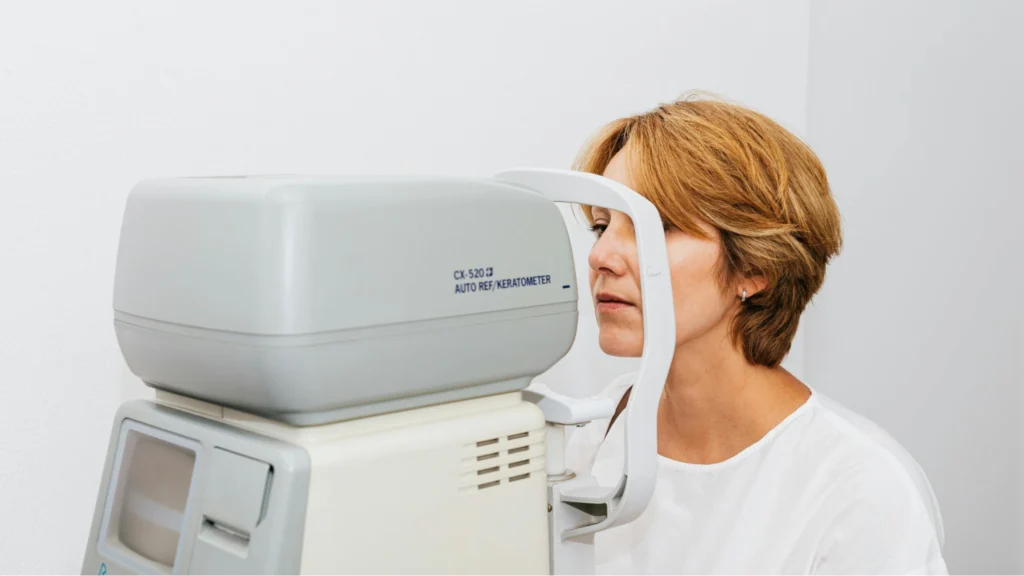
A comprehensive eye exam at LMC Optometry & Eye Care goes well beyond the standard letter chart. Our optometrists assess the full picture: how your eyes focus, how they work together, your field of vision, intraocular pressure, the health of your retina and optic nerve, and more.
This kind of thorough examination matters because it can catch changes early, when they’re far easier to manage. Conditions like glaucoma can be treated to slow progression significantly when detected early. Early cataracts can be monitored. Binocular vision issues in children can be addressed during a window of development when they respond much better to treatment.
In Ontario, routine eye exams for children under 20 and adults 65 and older are covered by OHIP. If you’re searching for an optometrist near me in Barrie, Thornhill, or Brampton, LMC Optometry & Eye Care has locations across Ontario to make access as convenient as possible.
Even if you’re between those age groups, the cost of a comprehensive exam is small compared to the long-term value of catching something early. Annual or biennial exams are widely recommended, not because something is necessarily wrong, but because many of the conditions most worth knowing about don’t give you a warning.
Frequently Asked Questions About 20/20 Vision
Does 20/20 vision mean perfect vision?
No. 20/20 vision measures only one aspect of how your eyes work: your central sharpness at a fixed distance. It doesn’t evaluate peripheral vision, depth perception, colour vision, contrast sensitivity, or the health of the structures inside your eye. You can have 20/20 acuity and still have a developing eye condition.
What is considered normal visual acuity?
In Canada, 20/20 is considered the benchmark for normal visual acuity. However, some people naturally see at 20/15 or 20/10, which is sharper than average. Visual acuity below 20/20 may indicate refractive error like nearsightedness, farsightedness, or astigmatism, which are all correctable with glasses or contact lenses.
Can I have eye disease with 20/20 vision?
Yes. Glaucoma, early diabetic eye disease, early macular degeneration, and several other conditions can develop without initially affecting your visual acuity score. This is one of the main reasons comprehensive eye exams are recommended regularly, even for people who feel like they see clearly.
What does a comprehensive eye exam check that a basic screening doesn’t?
A comprehensive exam checks visual acuity as well as peripheral vision, eye pressure, retinal health, optic nerve appearance, binocular vision, colour vision, and more. It uses equipment and techniques that no basic chart screening can replicate. Many serious conditions can only be identified this way.
How often should I get an eye exam if my vision seems fine?
Most adults should have a comprehensive eye exam every one to two years, depending on their age, health history, and risk factors. Children should be examined regularly as well, particularly before starting school. In Ontario, OHIP covers annual exams for children under 20 and adults 65 and older.
Can children have vision problems that school screenings miss?
Absolutely. School-based vision screenings typically only check basic distance acuity, which means they can miss binocular vision disorders, tracking issues, focusing difficulties, and other problems that directly affect a child’s ability to read and learn. A child can pass a school screening and still have a vision problem that’s affecting their performance in the classroom.
What are the symptoms of hidden vision problems?
Common signs include frequent headaches, eye strain, fatigue after reading or screen use, difficulty with night driving or low-contrast environments, sensitivity to glare, poor depth perception, and, in children, avoiding reading, tilting the head, or covering one eye. These symptoms often go unconnected to vision because the person still “sees fine” on a basic test.
Where can I get a comprehensive eye exam in Ontario?
If you’re looking for an optometrist near me in Barrie, Thornhill, Brampton, or elsewhere in Ontario, LMC Optometry & Eye Care has multiple locations across the province. You can book online at lmcoptometry.ca.
Book a Comprehensive Eye Exam at LMC Optometry & Eye Care
If you’ve been putting off your eye exam because you’ve been told you have 20/20 vision, this is a good moment to reconsider. Visual acuity is one piece of a much bigger picture, and the only way to know your eyes are genuinely healthy is to have them properly examined.
Book an appointment with us at the location nearest to you. Whether you’re coming in for yourself or bringing a child in for their first full exam, our team is here to make sure your eyes get the attention they actually deserve.