

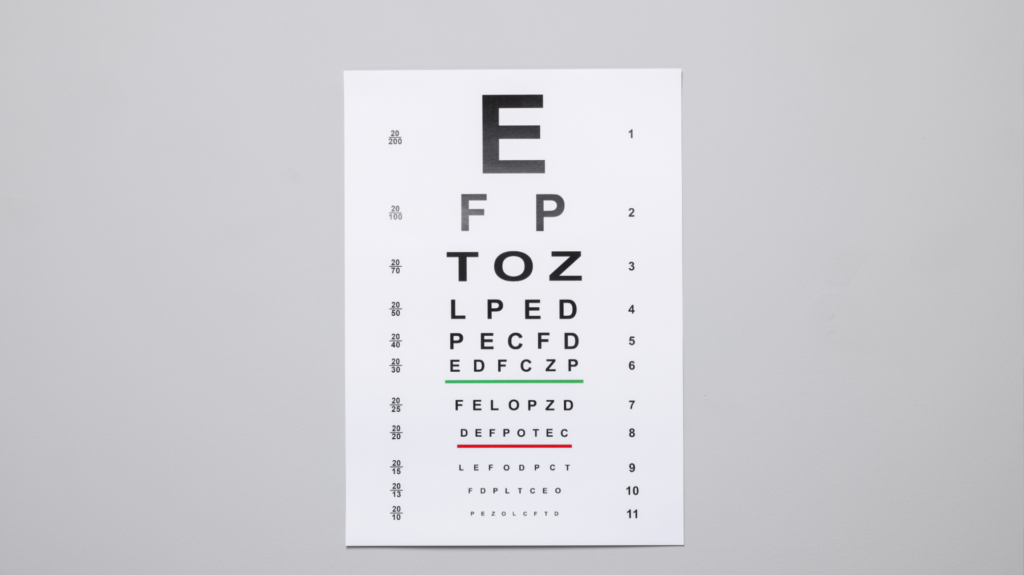
The MTO vision requirements for a regular Ontario driver’s licence (Class G or M) come down to two things. Your visual acuity can’t be poorer than 20/50 with both eyes open and examined together, and glasses or contacts are allowed. Your visual field needs to span at least 120 continuous degrees side to side, plus at least 15 continuous degrees above and below the point you’re looking at. Drivers 80 and over renew every two years, and that renewal session includes vision screening. A vision report from an eye doctor, signed or dated no more than six months before the session, can replace the on-site screening.
Maybe a renewal letter from ServiceOntario is sitting on your dad’s kitchen counter right now. Or maybe you’ve caught yourself squinting at a highway sign that used to be easy to read. Either way, the rules can feel fuzzy, and nobody wants a surprise on renewal day.
At LMC Optometry & Eye Care, we complete MTO vision report forms at all of our locations, and we hear the same worries every week. This post covers what the numbers mean, how the 80+ renewal works, what commercial drivers need, what’s billed, and what happens if your vision falls short. By the end, you’ll know exactly what to book and when.
Quick Facts: Ontario Driver’s Licence Vision Requirements
- Regular licence (Class G or M): Visual acuity no poorer than 20/50 with both eyes open, with glasses or contacts allowed.
- Visual field: At least 120 continuous degrees side to side, plus at least 15 continuous degrees above and below the point you’re looking at.
- Drivers 80 and over: Licence renews every two years, and each renewal session includes vision screening.
- Eye doctor’s report: Replaces the on-site screening when it is signed or dated no more than six months before your session.
- Commercial licence (Class A to F): At least 20/30 in your better eye, at least 20/100 in your weaker eye, and a visual field of at least 150 degrees.
- Cost at LMC Optometry & Eye Care: There is no charge for completing the MTO vision report form. The visual field test is billed separately because optometrists can’t bill OHIP for it.
What Does the MTO Vision Standard Actually Mean?
Two numbers do most of the work. One measures how sharply you see. The other measures how wide.
What 20/50 Vision Looks Like Behind the Wheel
With 20/50 vision, you see at 20 feet what someone with typical vision sees at 50 feet. In real life, that exit sign comes into focus a little later for you than for the driver in the next lane. The detail most people miss is that the MTO checks both eyes open together, so one weaker eye doesn’t automatically rule you out. For a closer look at how these fractions work, our post on what 20/40 vision means breaks it down.
What the 120 Degree Visual Field Covers
Your visual field is everything you can see without moving your eyes: the cyclist creeping up on your right, the car backing out of a driveway on your left. “Continuous” is the important word in the standard. A blind patch in the middle of that range can be a problem even if the edges are fine. To check it, optometrists run a visual field test for driving on an automated machine, and the binocular Esterman visual field test is a common choice. You press a button each time a small light flashes, and the machine maps what you caught and what you missed.
Do You Need Glasses to Drive in Ontario?
Only if you need them to meet the standard. The 20/50 rule applies with or without glasses or contacts, so plenty of people pass comfortably once their prescription is up to date. If your glasses are what get you there, wear them every time you drive, and bring them to any vision test.
How Does the Senior Driver Licence Renewal at 80 Work?
Once you turn 80, your Ontario licence renews every two years, and vision screening is part of each renewal session. Lots of families only think about it when the letter arrives and the session is already a few weeks away.
Can an Optometrist’s Report Replace the Vision Screening?
Yes. A vision report from an eye doctor replaces the on-site screening, as long as it’s signed or dated no more than six months before your session. That window trips people up, because an eye exam from last year often won’t count. Going this route means you walk in with the paperwork done and the vision piece already handled in a calm exam room. For adult kids juggling work and a parent’s appointments, that’s one less thing to stress about on the day.
What Are the Commercial Driver Vision Requirements in Ontario?
If you drive a truck, bus, or other vehicle that needs a Class A to F licence, the bar is higher. You need at least 20/30 in your better eye, at least 20/100 in your weaker eye, and a visual field of at least 150 degrees. Each eye is held to its own standard, so it’s smart to know where you stand before a new job or route comes with a paperwork deadline.
What Happens If You Don’t Meet the MTO Vision Standard?
It isn’t automatically the end of driving. Cataracts can blur acuity, and glaucoma can slowly chip away at side vision, often without you noticing. Both are reasons someone might fall below the line, and our guide to senior vision care covers these age-related changes. If glare and halos make evening drives tough, we’ve also written about night driving vision problems.
For Class G drivers who don’t meet the 120-degree field requirement, Ontario has an MTO vision waiver program. It’s good to know that option exists, and your optometrist can talk through whether it might apply.
Ontario optometrists are also required by law to report to the MTO when a patient’s vision falls below the driving standard. The Ministry makes the licensing decision, not your optometrist. The goal is safety and catching changes early, so problems get treated before they turn into a close call at an intersection. [CONFIRM: client is comfortable including the mandatory reporting point]
Is the MTO Vision Report Covered by OHIP?
At LMC Optometry & Eye Care, there’s no charge for completing the MTO vision report form itself. The visual field test the form typically requires is different. Optometrists can’t bill OHIP for third-party testing like this, so the visual field test is billed separately from OHIP. That’s true even if you’re a senior whose annual eye exam is OHIP-covered. We’d rather you know that now than be caught off guard at checkout.
Frequently Asked Questions
Can I drive with 20/50 vision in Ontario?
Yes. 20/50 is the minimum acuity for a Class G or M licence, measured with both eyes open and with glasses or contacts if you use them. If you’re right on the line, an updated prescription can give you more breathing room.
How recent does an MTO vision report need to be?
It must be signed or dated no more than six months before your renewal session. Once you have your session date, book an eye exam inside that window and leave a few weeks of buffer.
Is the renewal vision screening the same as a full eye exam?
No. The screening checks whether you meet the driving standard that day. A full eye exam also looks at the health of your eyes, which is how changes like early cataracts or glaucoma get picked up.
Is the visual field test for driving covered by OHIP?
No. Optometrists can’t bill OHIP for third-party testing, so the visual field test for an MTO report is billed separately from any OHIP-covered exam you qualify for.
Can I drive after cataract surgery?
That depends on how your eyes are healing, so follow the advice of the eye doctor managing your recovery. Once your vision settles, an optometrist can check your acuity and visual field against the MTO standard.
Ready for Renewal Day? Book Your Eye Exam First
The easiest renewal is the one where the paperwork’s done before the letter feels urgent. If you’ve been searching for an “optometrist near me” in Brampton, Barrie or Thornhill to sort out an MTO vision report, LMC Optometry & Eye Care can help at any of our eight Ontario locations. Book an adult or senior eye exam well before your session date, mention you need the MTO form, and walk in with one less thing on your list.