

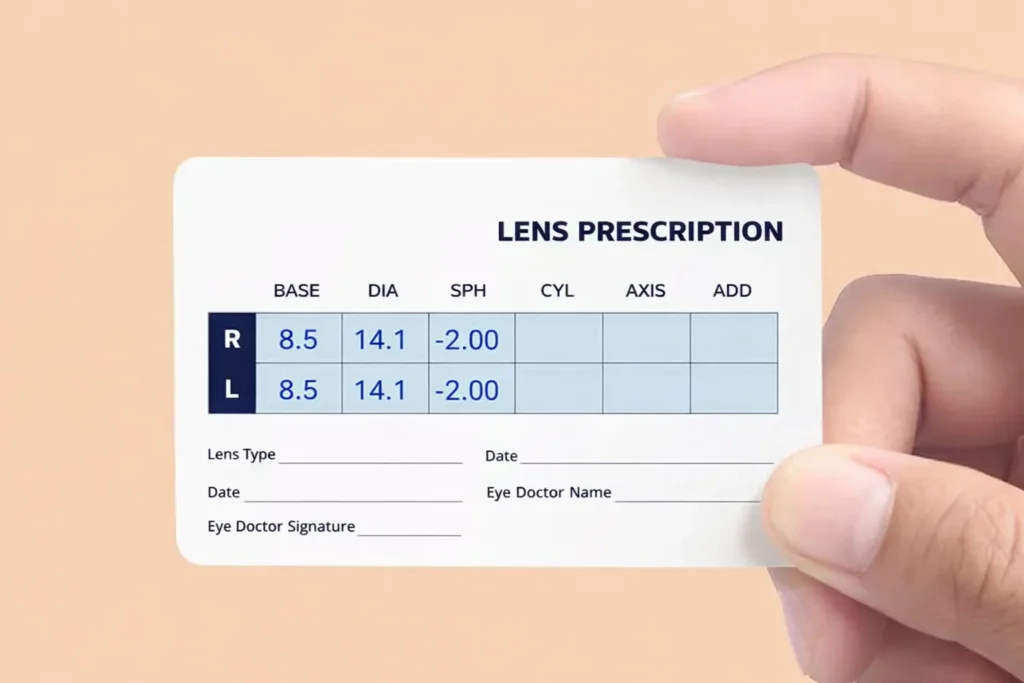
You’ve just had your eye exam. You’re holding a slip of paper covered in abbreviations and numbers that mean absolutely nothing to you. Sound familiar? Most people walk out of their appointment with a prescription in hand and no idea what it says or what to do with it next.
Choosing the right lenses matters more than most people realize. The type of lenses you get affects how clearly you see, how comfortable you feel after a long day on screens, and how well your glasses actually fit your life. Get it right and everything just clicks. Get it wrong and you’re stuck with headaches and a prescription that never quite feels correct.
This post walks you through what your prescription actually says and what the main lens options mean in plain language. By the end, you’ll know exactly what to look for and what questions to ask.
How to Read Your Eye Prescription
Your prescription is a set of measurements that tells a lens maker how to correct your vision. It looks complicated, but once you know what each term refers to, it’s pretty straightforward.
OD vs OS: Which Eye Is Which?
OD stands for oculus dexter (right eye) and OS stands for oculus sinister (left eye). Some prescriptions also include OU for both eyes together. Your optometrist measures each eye independently because they often have slightly different correction needs.
SPH (Sphere): Nearsightedness and Farsightedness
The sphere value is your lens correction power, measured in diopters. A negative number means you’re nearsighted (clear up close, blurry at distance). A positive number means you’re farsighted (close-up tasks like reading get blurry). The further the number from zero, the stronger the correction needed.
CYL and Axis: What Astigmatism Looks Like on Paper
CYL (cylinder) measures the degree of astigmatism, which happens when the cornea isn’t perfectly round and causes blurring at multiple distances. The axis number (between 1 and 180) describes the orientation of that correction in the lens. If your prescription has no CYL value, you either don’t have astigmatism or it’s too mild to correct.
ADD: Extra Power for Near Vision
The ADD value shows up when you need extra help with close-up vision, most commonly for people over 40 dealing with presbyopia. It’s the additional magnification added to the reading zone of a progressive or bifocal lens and is always a positive number, typically ranging from +0.75 to +3.00.
Prism: When Your Eyes Need Help Aligning
Prism isn’t in every prescription. It’s used when your eyes don’t align properly on their own, which can cause double vision or significant eye strain. The prism value redirects light so both eyes can work together without effort. If you see it on your prescription, ask your optometrist to explain what it means for your lens options.
Lens Types: What Are Your Options?
Single Vision Lenses
Single vision lenses have one focal point across the whole lens. They work for nearsightedness, farsightedness, and astigmatism when there’s no need for different corrections at multiple distances. If you only wear glasses for one type of task, single vision is usually the right call.
Progressive Lenses: Distance, Intermediate, and Near in One
Progressive lenses blend distance, intermediate, and near vision correction into a single lens with no visible line. They’re the most common recommendation for people with an ADD value in their prescription. There’s usually a short adjustment period, but most wearers get comfortable within a couple of weeks. If you’re tired of switching between multiple pairs of glasses, progressives are worth a serious look.
Bifocal vs Progressive: What’s the Real Difference?
Bifocals have two distinct zones separated by a visible line: distance on top, reading on the bottom. Progressives cover the same ground but add an intermediate zone and blend the transitions invisibly. The intermediate zone matters if you spend time at a computer, since bifocals can leave that distance awkward. Progressives are more versatile for most active adults.
High Index Lenses: Thinner for Stronger Prescriptions
If your sphere correction is above +/-4.00, standard lenses can turn out thick and heavy. High index lenses bend light more efficiently using denser material, producing the same correction in a noticeably thinner profile. They look better, sit more comfortably on your face, and are a worthwhile upgrade for stronger prescriptions.
Lens Coatings: What’s Actually Worth It?
• Anti-reflective coating: Reduces glare from headlights and screens. Almost always worth it.
• Blue light lenses: Filter a portion of blue light from screens. Research is still developing, but many patients at LMC Optometry & Eye Care report less eye fatigue with extended screen use.
• Photochromic (transition) lenses: Darken in sunlight and clear indoors. Useful if you move between environments frequently and don’t want separate sunglasses.
• Scratch-resistant coating: Lenses aren’t scratch-proof by default. This extends their life, especially if they’re often tossed in a bag without a case.
Choosing the Best Lenses for Your Daily Life
The best lens for you depends on how you actually live. If you’re at a desk most of the day, progressives with an anti-reflective coating and blue light filter make a lot of sense. If you’re mostly driving or outdoors, single vision with a photochromic coating might work better. Over 40 and finding that reading is getting harder? A progressive or a dedicated reading pair will make a noticeable difference.
At LMC Optometry & Eye Care, we talk through lifestyle and daily habits with every patient during a comprehensive eye exam. The prescription is just the starting point. The lens conversation matters just as much.
What People Frequently Ask About Lens Prescription
What do the numbers on my eye prescription mean?
SPH is the main correction power (negative for nearsightedness, positive for farsightedness). CYL measures astigmatism and axis describes its angle. ADD indicates extra near vision power. All values are in diopters.
How do I know if I need progressive lenses?
If your prescription includes an ADD value, you need different corrections for near and far distances. Progressives let you handle both with one pair. They’re the most common recommendation for adults over 40 with presbyopia.
Are blue light glasses worth it?
Research is still evolving, but many people who spend long hours on digital devices report less eye fatigue with blue light lenses. They’re a reasonable add-on if screen time is a big part of your day, though they work best alongside regular screen breaks and good posture habits.
Where can I find an optometrist near me in Ontario to help choose lenses?
If you’re searching for an “optometrist near me” in Ontario, LMC Optometry & Eye Care has clinics in Barrie, Thornhill, Brampton, and other locations across the province. Our team takes the time to walk through your prescription and match you with lenses that fit your vision needs and your lifestyle.
How often should I update my lens prescription?
Most adults should get a comprehensive eye exam every one to two years. Prescriptions change gradually with age, and wearing an outdated prescription can cause unnecessary strain and headaches. If your vision has shifted noticeably between appointments, book an exam sooner rather than waiting.
Ready to Find the Right Lenses?
Understanding your prescription is a great first step, but the real conversation happens when you’re sitting down with someone who can look at your numbers, understand your lifestyle, and help you make the right call. At LMC Optometry & Eye Care, that’s exactly what we do for patients across Ontario every day.
Book a comprehensive eye exam at one of our clinics and let’s find the lenses that actually work for your eyes and your life.